

Love comes in many forms and to celebrate Pride month, we can look at how people have expressed their identity and romance through jewellery.
Historically, same sex relationships have not always been kindly received. Falling in love with someone of the same sex could lead to social disapproval at best, and at worst, a prison sentence. Jewellery worn by gay men and women was often coded and can be difficult to establish historically and it’s likely that many jewels exchanged by gay couples are now completely unrecognised.
Very enthusiastic expressions of emotion in the 18th and 19th century probably made it easier to hide secret romances. Louis Mayeul Chaudon’s example of good letter-writing in 1787 reads:
‘Here it is, my dear FRIEND, this seal that you wanted so much. May it seal for a long time the secrets of friendship! I have had it made with a monogram where our two names are intertwined, just as our hearts are joined.’
If two friends could exchange seals and rings with their names joined together, many more intimate relationships could probably hide under this cover.
Revealing the histories of people who were marginalised or under-represented requires reading against the grain, picking up unspoken clues and filling in the blanks. Looking back, it’s sometimes hard to distinguish between a close friendship, which was often expressed in very warm terms, and a romantic relationship.
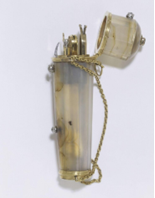
An exquisite little agate étui, containing useful items like a fruit-knife, needle, scissors and pencil, is inscribed ‘Masham from her Lovin’ Dux’.It was given by Queen Anne to her close friend, Abigail Masham around the start of the 18th century. If we believe contemporary rumours, shown in the 2018 film, The Favourite, Abigail was Queen Anne’s lover as well as her friend and adviser. Did the Queen invite Abigail to use ‘Dux’ as a loving pet name? We can never know the exact nature of the relationship but it was clearly of huge emotional importance to both women.
When two young men, Thomas White and George Lewis, ran away from home in 1862, they bought each other portrait lockets and had their photographs taken to put in them. They were arrested on theft charges in Plymouth and interrogated about the portrait lockets they each owned. Each of them stated they had paid for the locket and photograph as a gift to the other. Were they just good friends or something more? As male homosexuality was punishable with prison and hard labour, they certainly couldn’t have acknowledged their relationship openly but perhaps wanted their own private tokens of love.
When author Oscar Wilde and fellow student Reginald Harding gave a ring inscribed ‘A gift of love to one who wishes for love’ to their mutual friend William Ward, who was leaving Magdalen College in Oxford, it was most likely a gesture of friendship rather than romance.
However, Wilde’s jewellery gifts to his lover Lord Alfred Douglas (Bosie) were certainly expressions of romantic and physical love. Wilde gave Bosie a gold cigarette-case, a pearl chain and an enamelled locket (maybe to hold a picture of Wilde?) among other gifts and was keen to retrieve them after the disastrous trial which sent Wilde to prison. According to one of Wilde’s earlier lovers, he also gave him jewellery. The evidence presented during the trial reveals that Wilde ‘gave me a silver cigarette-case and a gold ring. I don’t suppose boys are different to girls in acquiring presents from those who are fond of them.’
Exchanging love gifts is a delightful part of many relationships and although gay couples couldn’t legally marry until recent changes in legislation, many couples wanted to mark their relationships, often as part of a private exchange. Anne Lister (of ‘Gentleman Jack’ fame), as an heiress and orphan, enjoyed an unusual degree of freedom in expressing her love for women. Her diaries (written in code to preserve her privacy) describe the long and serious relationships she entered into. She exchanged jewels with her great love, Mariana Belcombe, giving her a gold wedding ring and, later a chain, writing in her diary ‘She is my wife in honour & in love & why not acknowledge her [as] such openly & at once?’. Sadly, Mariana was not able to resist social and economic pressures and went on to marry Charles Lawton rather than living with Anne Lister in an informal marriage.
In 1834, Anne confided in her aunt her desire to set up home with Ann Walker, another local heiress, and described their relationship as ‘as good as a marriage’. Anne explained that Ann Walker ‘is to give me a ring & I her one in token of our union as confirmed on Monday’.
Although their marriage wasn’t recognised by the Church or the law, Anne Lister’s family seem to have known and accepted it. Having an independent income allowed the two women to break the social norms and live openly as a couple. They were also aided by the fact that, unlike men, female homosexuality wasn’t criminalised in England.
Modern same sex couples, if they wish to marry, can find a fine range of jewellery from many firms and makers. In 2015, Tiffany became the first major firm to feature a gay couple in their ‘Will You?’ marketing campaign for wedding and engagement rings, stating that “True love can happen more than once with love stories coming in a variety of forms.”, a sentiment which remains true today as it was in the past.